
What to Do at 3 A.M.
If something is happening right now: If the person is on hospice, call the 24-hour hospice number. You don’t need to know what’s wrong. Just say what you see. If the person isn’t on hospice, call the doctor’s after-hours line. If there’s danger that can’t wait, call 911.
The middle of the night is when fear hits hardest. The house is dark, everyone else is asleep, and you’re listening to each breath, trying to decide whether something changed or whether you’re only noticing it because everything is quiet. Is that breathing normal? Was I supposed to give the medicine? Do I call the nurse, or 911?
No one expects you to know what to do at 3 a.m. You need to know who to call and what to say.
You Don’t Have to Know What’s Happening Before You Call
You don’t have to know whether the person is actively dying, whether the breathing is normal, or whether the restlessness is pain, fear, medication, or something else. You don’t have to know whether you’re overreacting.
You can call because you don’t know.
If the person is on hospice, that’s what the number is for. Hospice must have clinical support available around the clock. You can say:
“His breathing changed and I don’t know if this is expected.”
“She looks uncomfortable and I don’t know what to give her.”
“He fell.”
“I think he may be dying. Can you talk me through what I’m seeing?”
Describe What You See, Not What You Think It Is
At 3 a.m., families reach for the scariest word available.
“He’s suffocating.”
“She’s having a seizure.”
“She’s in terrible pain.”
Maybe. But the nurse needs the details underneath that conclusion:
“He takes four quick breaths and then doesn’t breathe for about fifteen seconds.”
“She keeps pulling at the sheets and trying to climb out of bed.”
“She’s grimacing and moaning when we move her.”
“There’s blood in the bed and it soaked through the sheet.”
You don’t need medical words, and you don’t need a monitor. Near the end of life, oxygen levels and blood pressure often tell you less than the person in front of you.
If they look frightened, are grimacing, or seem to be fighting for breath, say that.
Describe what you see, not what you think it is.
If Medication Is Part of the Plan, Follow the Plan
Hospice may leave medications in the home for pain, breathlessness, anxiety, restlessness, nausea, or secretions.
At 3 a.m., that little box can feel enormous.
What if I give too much?
What if she dies right after I give it?
Don’t invent a dose or use a medication in a way you weren’t taught. If the instructions clearly cover what you’re seeing, follow them.
If you aren’t sure, call:
“This is what I’m seeing. This is what the instruction says. Do you want me to give it now?”
When comfort medication is given as directed, its purpose is to ease symptoms as the disease progresses.
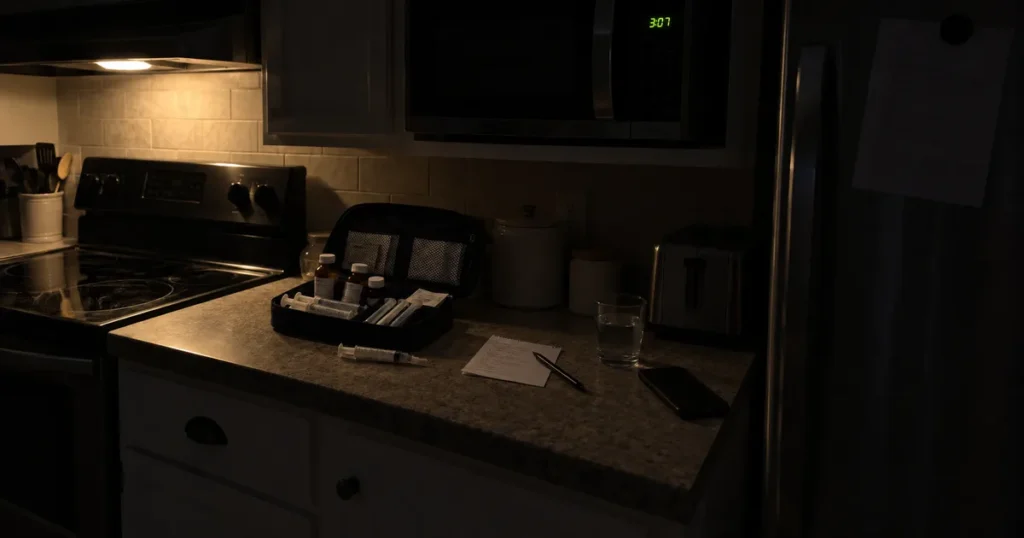
Whenever you give something, write down what, how much, what time, and for what symptom. A scrap of paper on the kitchen counter is enough.
The point is to avoid giving the same dose twice because everyone is exhausted.
Wake Someone Up
Caregivers decide everyone else needs sleep more than they do.
So they sit alone, lift someone they can’t safely lift, and keep making decisions long after they can think clearly.
Wake your spouse. Call your sister, or the neighbor who said to call anytime.
If the person needs two people to move safely, don’t make 3 a.m. the moment you prove you can do it alone.
The patient isn’t the only person whose safety matters.
If You Call 911
Hospice should be your first call for uncontrolled pain or breathlessness, severe agitation, a fall, bleeding, or any change you weren’t prepared for.
The nurse may talk you through it, send someone out, or tell you more help is needed.
If there’s danger that can’t wait (dyingtruth.org/i-need-emergency-help), call 911.
Tell responders right away that the person is on hospice, and show them the out-of-hospital DNR or POLST-type order (dyingtruth.org/help-finder/prepare-for-a-medical-emergency) if there is one.
A hospital DNR, an advance directive, and an out-of-hospital medical order aren’t necessarily the same thing, and emergency responders may need a specific form they’re authorized to follow.
Then call hospice and tell them 911 was called.
That form only helps if someone can find it.
Ask the care team now:
“If paramedics come to this house, what do they need to see, and where should we keep it?”
If You Don’t Have Hospice
Without hospice, there may be no single team to guide you through the night.
Find out now whether the treating clinician has an after-hours number and what they want you to do if symptoms change.
In an emergency, call 911, with any order limiting resuscitation ready for responders.
If the person is nearing the end, ask:
“If they die at home, exactly who do we call?”
Write down the answer.
If They Die
If the person is on hospice and the death was expected (dyingtruth.org/help-finder/what-to-do-when-someone-dies), call hospice.
You usually don’t need 911 unless hospice has told you otherwise or something seems unexpected or unsafe.
If the person isn’t on hospice, call whoever you were told to call. If you don’t know, call 911.
Then stop.
Nothing has to be cleaned, decided, or announced right away.
For months, everything may have felt urgent. This usually isn’t.
Make 3 A.M. Easier at 3 P.M.
The 7 Things for 3 A.M.
Before tonight, know:
- the 24-hour hospice or after-hours number
- where the medications and instructions are
- which medications you’ve been taught to give, and when
- which symptoms should trigger a call
- where the out-of-hospital DNR or other portable order is
- who you can wake up, and who can come to the house
- who to call when the person dies
Ask now, even if it feels premature.
At 3 a.m., your job isn’t to become the nurse. It’s to notice what changed, keep the person as safe and comfortable as you can, and get help.
Helpful reads
- What Dying Actually Looks Like (dyingtruth.org/articles/what-dying-looks-like)
- Who Takes Over If the Caregiver Can’t? (dyingtruth.org/articles/caregiver-backup-plan)
- Dying Without Hospice (dyingtruth.org/articles/dying-without-hospice)
Read more
When Someone Is Dying
How to Choose a Hospice
When Someone Is Dying
Dying Without Hospice

When Someone Is Dying
How Hospice Works
When Someone Is Dying
What Dying Actually Looks Like

When Someone Is Dying
When Eating Stops

The Rest of Us
When the Help You Expected Isn’t There
When Someone Is Dying
When You’re the One Dying
Decisions That Shape Dying
Dying Happens to a Household

The Rest of Us
Who Takes Over If the Caregiver Can’t?

The Rest of Us
When Caregiving Ends and You Don’t Know Who You Are

Decisions That Shape Dying
When Treatment No Longer Fits

The Rest of Us