
When the Help You Expected Isn’t There

Most families assume that when caregiving becomes too much, more help will appear. They’ll hire someone. Insurance will cover it. Hospice will send more people. Medicare will pay. Mom can go to a facility. A social worker will know who to call.
Sometimes one of those things works. Sometimes none of them does. The help gap is the space between the care someone needs and the care that’s actually available. Families discover it after they’re already standing in it.
Someone Has to Do It
A person can be medically ready to leave the hospital and still need help getting to the toilet, taking medications, changing clothes, eating, getting out of bed, or staying safe through the night. Someone has to do those things. The health care system often assumes there’s a person at home: a spouse, a daughter, a son who lives nearby, someone who can “help at home.”
But being family doesn’t make someone able to lift another adult. It doesn’t create another bedroom, paid leave, money for private caregivers, or the ability to stay up all night and go to work the next morning.
Professionals do this work in teams, with equipment, training, and shifts. Families do it in bedrooms and bathrooms, and often one person ends up doing most of it. That person may be seventy-eight with a bad back, raising children, living forty miles away, or already missing work. None of that changes how much care the sick person needs. It only changes who absorbs the gap.
Where the Gap Comes From
Much of the gap comes from one fact families rarely hear in time: Medicare generally doesn’t pay for long-term custodial care. That’s the ongoing help with bathing, dressing, toileting, eating, and supervision. Its home health benefit covers part-time skilled care and some aide visits, not shifts. Medicaid can pay for some long-term care (dyingtruth.org/help-finder/medicaid-long-term-care) at home or in a facility for people who qualify, but programs and waitlists vary by state.
Before assuming everything is private pay, check two things. If the person is a veteran, ask the VA about benefits that may help pay for care at home. If they ever bought long-term care insurance, find the policy.
“Home” Isn’t the Same as “Care”
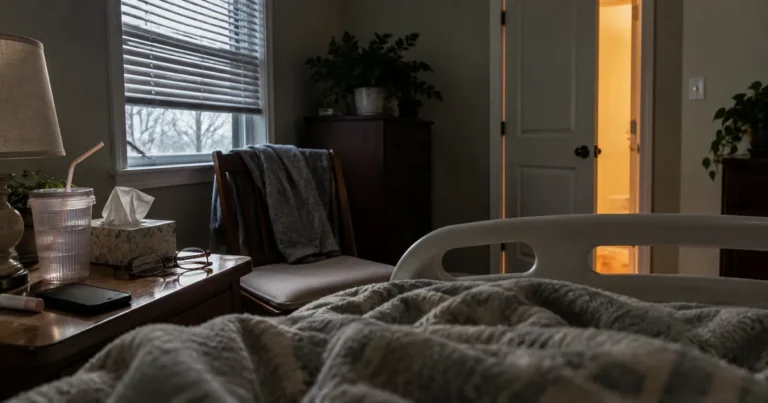
Families are often asked whether they want to take someone home. That sounds like a question about place. It’s also a question about labor.
Who will be there at 2 a.m.? Who will change the wet sheets? Who will help when the person can no longer stand, give the medication, and stay when they can’t be left alone? Who gets up the second, third, and fourth time?
Those questions matter as much as whether the person wants to be home. Wanting someone home and being able to care for them there aren’t the same thing. That isn’t a failure of love. It’s a question of what the household can do.
Hospice Helps. Hospice Doesn’t Move In.
Hospice can provide nurses, aides, social workers, chaplains, medications, equipment, teaching, and a 24-hour phone line. What families often don’t understand until admission is that hospice usually comes in visits. Between them, family, friends, facility staff, or paid caregivers are still doing most of the hands-on care.
A hospice nurse may teach you how to give the medication, but won’t usually stay until the next dose is due. The social worker can help you look for respite, placement, or paid help, but can’t create a caregiver where none exists. That isn’t hospice failing. Hospice was never meant to provide round-the-clock custodial care. Families need to know that before the need becomes round-the-clock.
If symptoms get out of control, ask whether the person qualifies for a higher level of hospice care, either a nurse in the home for extended hours during a crisis or a short inpatient stay. Ask about respite care (dyingtruth.org/help-finder/respite-care) too, when the caregiver needs a few days.
Paid Help Has Limits Too
When families hear they may need private-duty care, there’s often a moment of relief. Then they hear the price.
A few hours a day may be manageable for some families. Around-the-clock care is another matter. Even families who can pay may run into staffing shortages, minimum shifts, higher costs for nights and weekends, workers who call out, or agencies that can’t provide the level of care the person now needs. Before hiring, ask exactly what the worker will and won’t do, and “What happens when the scheduled caregiver doesn’t show up?”
Hiring help can reduce the physical work while creating a different kind of work: scheduling, supervising, replacing workers, and making sure the care actually happens. Someone stays responsible for the whole operation, and usually that person is family. You can appreciate someone’s effort and still decide they’re not right for your home. If anything about a paid caregiver feels wrong, like rough handling, unexplained injuries, or requests for money, raise it with the agency. If you believe the person is being harmed, contact Adult Protective Services.
Placement Isn’t a Simple Escape Hatch
The next assumption is often: then we’ll place her somewhere. Maybe. But “somewhere” has to have an open bed, accept the person’s level of care and payment source, manage the behaviors or equipment involved, and be a place the family is willing to use.
Assisted living may not be able to handle someone who now needs two people to transfer. Memory care may manage wandering but not complex medical needs. Skilled nursing may be right but unaffordable without Medicaid or another payment source. A facility may say no. Families can spend days calling buildings (dyingtruth.org/help-finder/find-a-care-facility) that seem to offer the same thing before learning that the labels matter less than what each place is staffed and licensed to do.
This is when a family hears:
“She’s too much care for assisted living.”
“He doesn’t qualify for rehab anymore.”
“We can’t manage that behavior.”
“We don’t have a Medicaid bed.”
“He can’t safely go home.”
All of those can be true at the same time.
That’s the gap.
The Caregiver Usually Feels It First
Health care systems measure blood pressure, wounds, medications, falls, and hospitalizations. The caregiver measures something else. How many nights since I slept? Can I get him off the toilet one more time? What happens if she falls while I’m at work? How long can I keep doing this?
Those questions belong in the care plan too. A plan that depends on one exhausted person continuing indefinitely has a hole in it.
Exhaustion, frustration, anger, and loneliness don’t make someone a bad caregiver. They’re signs that one person is carrying more than one person should.
Sometimes the most important thing a social worker does is stop talking about what would be ideal and ask what’s actually possible. Who’s doing the care now? What can they safely do, and what can’t they do anymore? Who else can help? What happens if the caregiver gets sick? What happens tonight? Those questions can sound pessimistic. They’re how you keep one sick person from becoming two.
Ask for the Help You Need
Families are often told to “reach out for support.” That’s too vague. Name the task.
Instead of “We need some help with Mom,” say, “She can’t be left alone anymore, and I have to work. What options do we have for supervision?” Instead of “Things are getting harder,” say, “My father now needs two people to transfer him, and I can’t do that safely.” If you’ve been awake for three nights, say that. If home will only keep working with someone covering Tuesdays and Thursdays from noon to five, say that. People can act on a task. “We’re overwhelmed” gives them nowhere to start.
If you’re working, ask HR early what leave you may qualify for, including job-protected leave under federal FMLA or any state or employer program. Don’t wait until missed shifts become their own crisis.
Sometimes the answer will still be no. Then ask, “Who should I try next?” Social workers do this constantly. One call becomes another. The hospital social worker calls the facility. A daughter calls a cousin, who calls a church member. A neighbor takes Wednesday. Someone pays for Friday. A respite bed opens for five days. None of it looks like the neat care plan anyone imagined. It still counts.
Sometimes There’s No Good Solution
This is the part people are least prepared for. Sometimes every available choice has a cost. Home may mean an exhausted spouse. Placement may mean spending savings. Private care may be unaffordable. The preferred facility may have no bed. A daughter may have to cut her hours. Someone may have to move.
The family may choose the option nobody wanted because it’s the only one that can be carried out. Social work can’t always turn a bad set of choices into a good one. Sometimes the work is helping people see the choices clearly enough to decide which burden they can live with. That’s different from fixing it, and it matters.
Start Before You Need the Rescue
If someone you love is getting weaker, falling more often, or needing more supervision or physical help, don’t wait until the current caregiver collapses. Write down every caregiving task, who’s doing it, and which ones already take another set of hands. Ask what happens if the person doing most of it can’t. Ask what you can afford, what insurance actually covers, what local help exists, what would make home stop working, and where you’d go then.
You don’t need every answer today. You do need to know which part of the plan depends on somebody doing more than they can keep doing. Eventually, somebody reaches that limit. The mistake isn’t reaching it. It’s building the whole plan as though they never will.
Helpful reads
- Who Takes Over If the Caregiver Can’t?
- Dying Happens to a Household
Read more
When Someone Is Dying
When You’re the One Dying
Decisions That Shape Dying